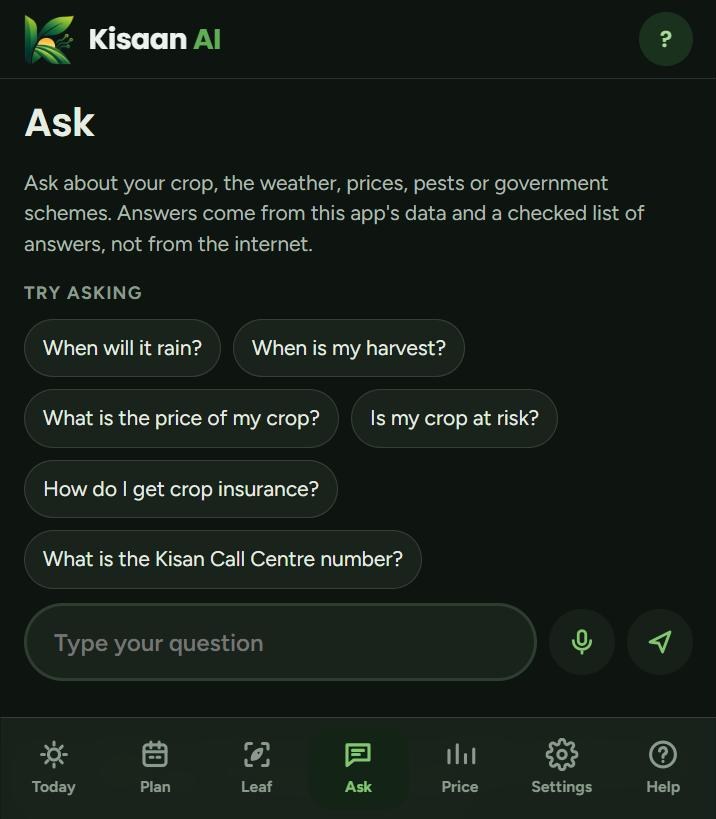
Crop Price Prediction
Tracks prices for the crop a farmer is growing, alongside MSP figures, so selling decisions are less of a guess.
Building AI for real-world agricultural problems.
Kisan AI is a self-built AI assistant designed to support farmers by combining crop price prediction, weather forecasting, crop suggestion, computer vision, and language translation into a single accessible tool.
Live web app for farmers across the districts of Andhra Pradesh and Telangana
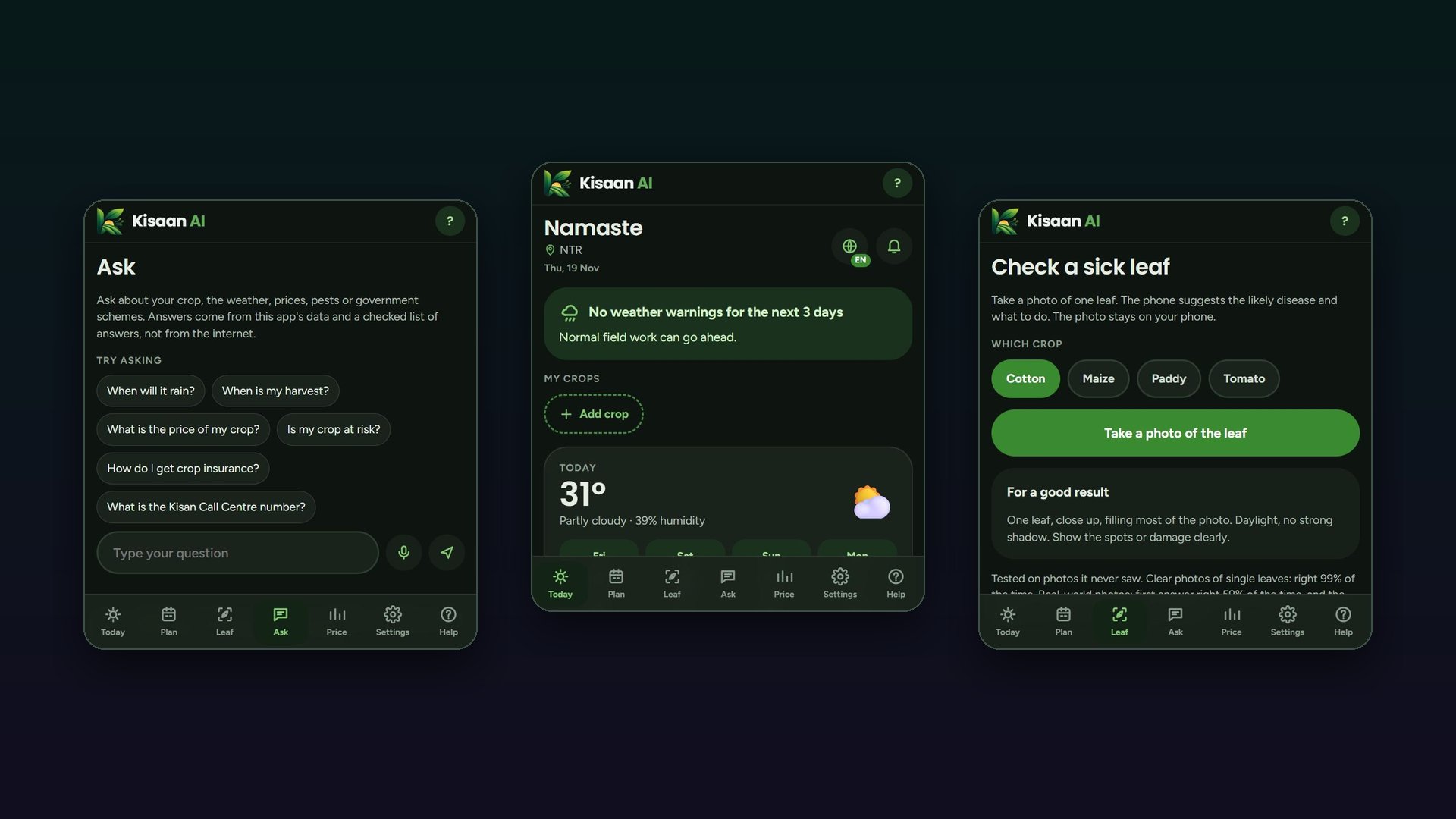
Tracks prices for the crop a farmer is growing, alongside MSP figures, so selling decisions are less of a guess.
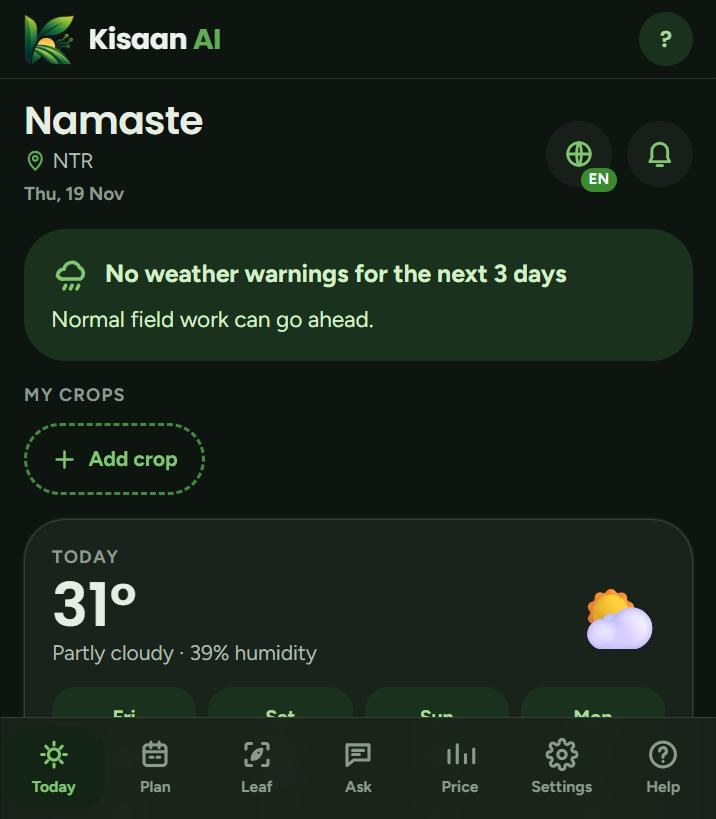
A local forecast with 3-day weather warnings, plus season forecasts for drought from an XGBoost model.
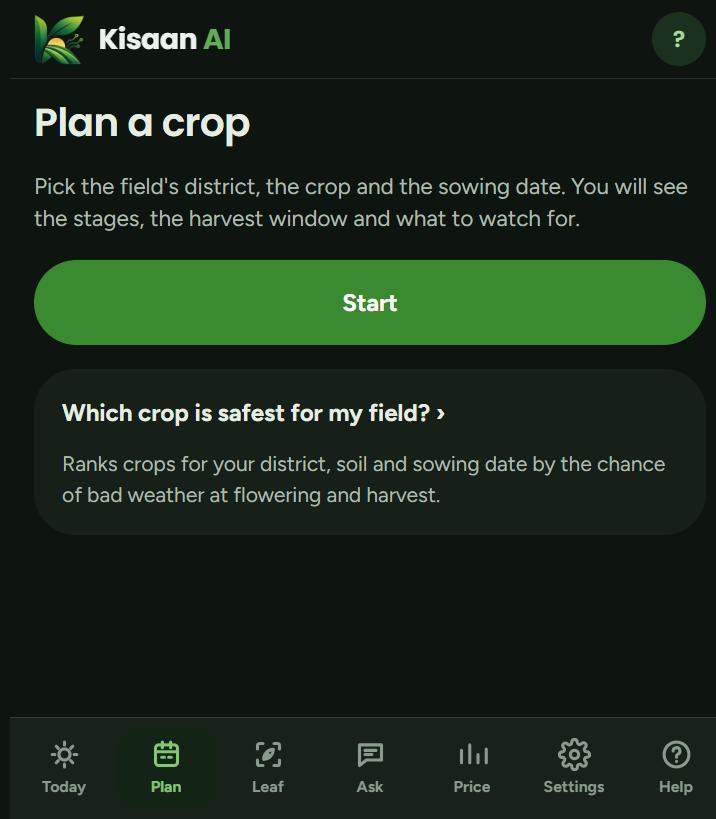
Ranks crops for a district, soil and sowing date by the chance of bad weather at flowering and harvest.
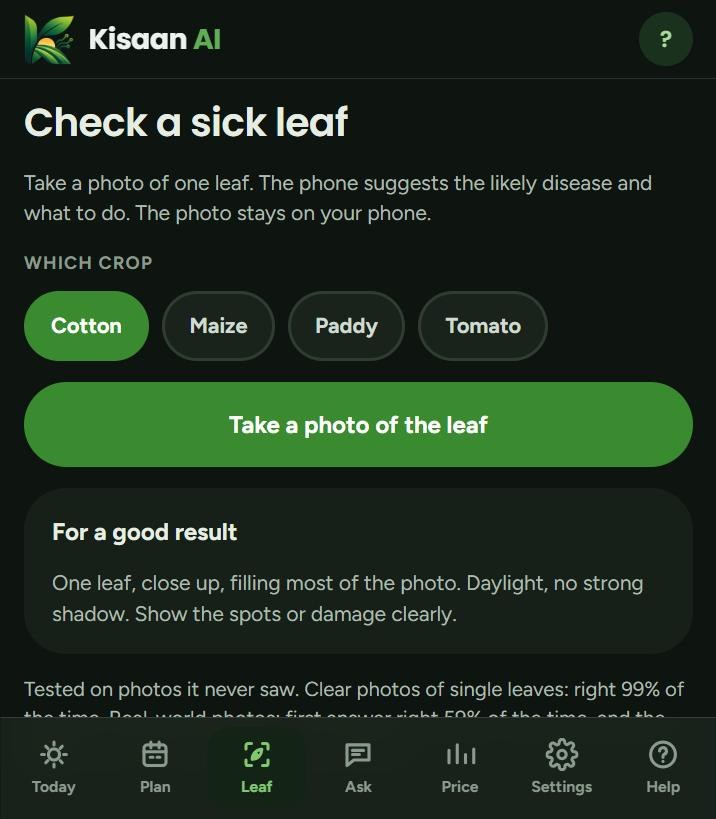
Suggests the likely disease from a photo of a cotton, maize, paddy or tomato leaf. The photo stays on the phone.
Works in six languages (English, Telugu, Kannada, Hindi, Tamil and Malayalam) with voice input.
Farming is a chain of decisions made under uncertainty: what to plant, when the weather will turn, whether a leaf is diseased, and when prices make it worth selling. The information that could help is spread across different places, often written in technical language, and often not in the farmer’s own language.
Edit: describe the specific problem you saw, and what made you want to work on it.
Instead of building one more single-purpose tool, I wanted to put five capabilities behind one simple assistant. A farmer should not have to know which model answers which question. They pick their district once, and every forecast, warning and suggestion follows from there.
I designed and built Kisan AI end to end.
The hardest part was not any single model. It was making separate systems work together as one product: the district a farmer picks drives the weather, the warnings, the crop plan and the season forecast, and the farmer sees one clear screen called Today.
The people Kisan AI is built for are experts in farming, not in technology. So it works without an account, keeps data on the phone (nothing is uploaded), speaks six languages, and uses plain words like “Check a sick leaf”. It is also honest about its limits: it shows how accurate each model is, and reminds farmers to confirm with their agriculture officer before spending money or spraying.
Kisan AI taught me how to integrate multiple AI systems into a single working product, and that designing technology for real-world users is as hard and as important as building the models themselves.
It also taught me how big the gap between the lab and the field is. On clear photos of single leaves, the leaf model is right 99% of the time. On real-world photos, its first answer is right 59% of the time, and the right answer is in its top three 90% of the time. That gap, between controlled conditions and messy real ones, is exactly what my robot navigation research is about.
The next step is taking Kisan AI off the screen and into the field. My ongoing research on vision-based robot navigation explores how Kisan AI’s computer-vision module could be extended into a physically navigating field robot.
Edit: add your other future plans (for example expert review of the advice, more crops, or price forecasts).
Related writing: Why rural AI can’t wait for the cloud · Why federated learning is the future of rural privacy