AI / ML · Research · Building
Hi, I'm Darsh.
I teach machines to see, to forget, and to help.
AI & Computer Science Student | Builder | Researcher
Between a dataset and a farmer's field there's a gap where a model stops being an idea and has to become useful. That gap is where I like to work. I'm a student from Vijayawada who built Kisan AI to bring crop prices, weather and crop advice to farmers in their own language, wrote a published paper on how trained models can unlearn what they were taught, and am now researching how robots can find their way through places that were never designed for them.
model darsh.v12
- input
- real-world problems
- trained on
- CS50 · 14 blogs
- shipped
- Kisan AI ● live
- published
- Machine Unlearning
- exploring
- robot navigation
- output
- useful AI
loc 16.51°N 80.65°E
focus ai · cv · robotics
status building ▍
AI•Machine Learning•Computer Vision•Robotics•Research
How I work, written as a model would see it
- 01InputA real problem worth solving.
- 02DataResearch: reading, questioning, testing assumptions.
- 03ModelBuild: code, systems, prototypes.
- 04PredictionExperiment: does it actually work?
- 05DecisionExplain: write it down so others can use it.
- 06ImpactApply: put it in front of real people.
Kisan AI.
Building AI for real-world agricultural problems.
Self-built · LiveFounder / Builder
Kisan AI is a self-built AI assistant designed to support farmers by combining crop price prediction, weather forecasting, crop suggestion, computer vision, and language translation into a single accessible tool.
- 01Crop Price PredictionTracks prices for the crop a farmer is growing, alongside MSP figures, so selling decisions are less of a guess.
- 02Weather ForecastingA local forecast with 3-day weather warnings, plus season forecasts for drought from an XGBoost model.
- 03Crop SuggestionRanks crops for a district, soil and sowing date by the chance of bad weather at flowering and harvest.
- 04Computer VisionSuggests the likely disease from a photo of a cotton, maize, paddy or tomato leaf. The photo stays on the phone.
- 05Language TranslationWorks in six languages (English, Telugu, Kannada, Hindi, Tamil and Malayalam) with voice input.
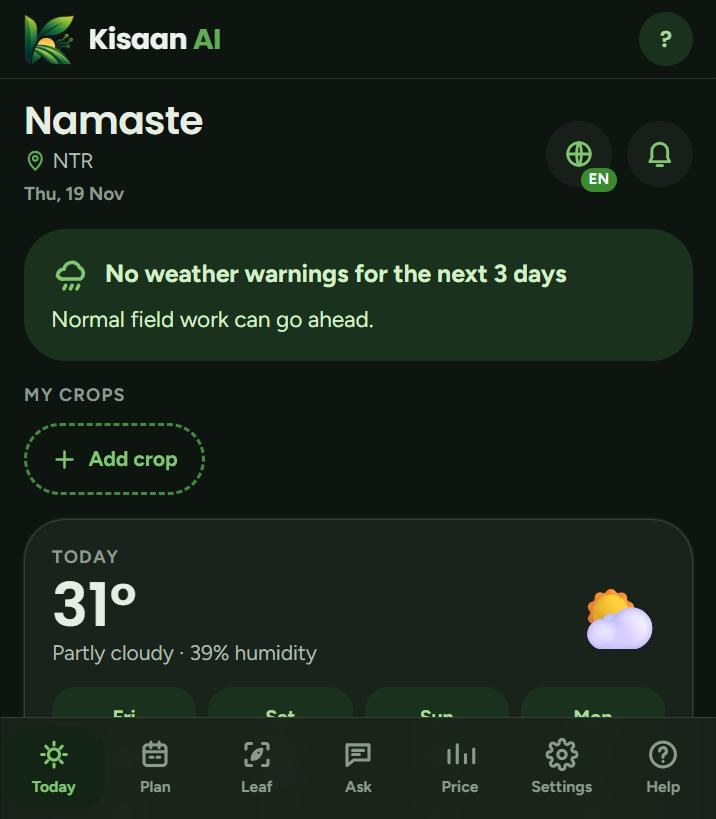
- 01ProblemFarmers make high-stakes decisions with scattered information.
- 02ResearchDistrict-level agro-climatic zones, decades of weather data.
- 03AI ModelsSeason forecasting, crop ranking, leaf disease detection.
- 04IntegrationWeather, prices, planning, vision and Q&A in one app.
- 05User AccessibilitySix languages, voice input, plain words, no account needed.
- 06Real-World ApplicationLive for farmers in Andhra Pradesh and Telangana.
Asking what models really do.
Research is where I slow down and ask what a system is really doing. My work so far follows one thread: from how models handle data, to how AI helps people, to how it might eventually move through the physical world.
Published ResearchIndependent Researcher
Machine Unlearning
An independently authored research paper studying techniques that allow trained AI models to selectively "forget" the influence of specific data points. Published in the peer-reviewed IOSR Journal of Computer Engineering in Grade 11.
Read the case study →Ongoing ResearchIndependent Researcher
Vision-Based Robot Navigation
A comparative review of classical geometric SLAM and deep-learning-based approaches to vision-based robot navigation, across structured indoor and urban settings and unstructured outdoor and agricultural ones.
Read the case study →One curiosity, ten verbs.
I don't just learn about technology. I build it, research it, explain it and try to put it to work, and I care about the people on the other side of it.
Building→ Kisan AIResearching→ Machine Unlearning→ Robot NavigationInnovating→ IIT Kharagpur Young Innovators ProgrammeLearning→ Harvard CS50Writing→ 14BLOGS: 14+ AI / CS blogsCompeting→ IJAIO Gold (India Rank 1)→ INAIO Stage 2 (ACM India)→ SEAMO BronzeWorking→ Best Brains web internshipLeading→ Head BoyCommunicating→ MUN & debateServing→ Community & policy initiatives
Explaining what I learn.
Data Centres: The Unglamorous Infrastructure Running the AI Revolution
Every chatbot response has a physical cost in watts, litres and square metres. Inside the buildings that power AI.
Read more →The Alignment Tax: Does Making AI Safer Make It Less Useful?
Every refusal has a cost. Is the trade-off between safety and usefulness real, and can it be made smarter?
Read more →The AI Compute Race: GPUs, TPUs, and Why Hardware Determines Who Wins
Who controls the chips controls the future. Why semiconductors have become the centre of AI geopolitics.
Read more →// output